This article is a work in progress, it’s goal is to document Irwin auger bits from the very beginning in 1885 up to the 1950’s/60’s. The aim is to help collectors identify and date Irwin auger bits and other packaging artifacts. The research is currently being carried using publicly available document. I tried to provide as many links and references as possible, i will eventually add a reference section. If you have complimentary information, spot a mistake or want to say something, do not hesitate to post a comment. I am looking for more materials such as advertisements, articles, catalogue, brochures, … If you’re in possession of such documents, please contact the author directly (CHGANS AT GMAIL DOT COM), or leave a comment.
Enjoy!
The Irwin Auger Bit Company
From WikipediA:
Irwin was founded in 1885 in Martinsville, Ohio as the Irwin Auger Bit Company by Charles Irwin, a pharmacist. Irwin had bought the rights to a solid-center auger bit from a local blacksmith.
W. M. “Mack” Dimmit, a client of Irwin’s pharmacy, was a highly skilled blacksmith, his 1884 patent was assigned at 50% to Charles H. Irwin as a form of payment for a debt at his pharmacy, he died in 1918.
The Irwin Bit Company was founded in 1885 by Charles H. Irwin, backed by Wilmington Citizens, J.W. Denver, Peter Clevenger and A. I. Bailey for funding the production. The company was reportedly capitalised at 50,000$. Irwin secured an agreement that he receives one cent for every bit sold during the life of the patent.
Charles Irwin improved the original patent in 1887 by adding a second, short convoluted blade at the advanced end of the stem.
There is an interesting story reported in 1897, claiming that someone had an auger bit for years that resembles the Irwin bit quite strongly, and that this bit was nearly 100 year old when the person got it.
In 1890, The single cutter pattern is advertised as The Irwin Solid Center Stem Auger Bit, and the machine version as The Irwin Boring Machine Auger.


By 1890, Irwin was manufacturing:
- Carpenters’ augers
- Eye augers
- Hollow augers
- Millwright augers
- Ship augers
- Tree-nail auger
- Gas fitters’ augers
In 1891, Irwin advertises the Irwin Dual Cutter Auger Bit which is the form as we know it today.

In 1894, S. A. Haines is a representative agent of The Irwin Auger Bit Company in the U.S.
In 1896, S. A. Haines sailed to Europe with the view to making arrangement for the sale of [..] bicycles and lawn mowers, nothing related to auger bit it seems, but it is said that Haines was an agent for The Irwin Auger Bit Company, among others.
By 1899, Irwin was manufacturing as well:
- Car bits
- Screw driver bits
- Conveying machines
- Counter sinks
- Nail sets
- Boring machine augers
- Ship tree-nail auger
In 1900, Irwin is an exhibitor of the International universal exposition, Paris. One year after the Eiffel tower was constructed for the previous edition.
In 1907, The Irwin Auger Bit Company trademark was registered. It is certainly in this period that the word Irwin was registered.
Around 1910, it looks like The IRWIN Bit branding was in search of identity, In Collier’s, Volume 45, 1910, one can see this interesting illustration where the word Bit is replaced by an actual picture of an Irwin bit, laid horizontally on top of The IRWIN.

By 1913, Irwin claim to have 6500 styles and size of the Irwin bit, this is quite an astonishing number!

In the 1920’s, The IRWIN Bit branding was at it’s highest with the arrival of the Bor marketing concept, everything was named after Bor.
The IRWIN Bit branding disappeared later in the 1930’s and was replaced with IRWIN Boring tools. Cut true – Clear thru. In this period the old Bluwin finish became a commercial product on his own.
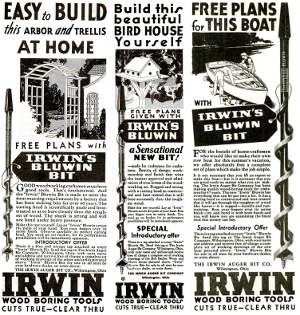
In the early 1930’s, Irwin introduce Trubor, the first Irwin‘s expansive bit
TODO: 40s, 50s, … and final merge history up to Stanley Black & Decker.
Bit marking
Here we’ll focus on markings found on the Irwin patented bit, and mainly on the early ones, eg. from 1985 up to the 1920’s/1930’s.
Markings will be given a nick name, so that it is easy to reference them throughout this article.
We’ll start with the Charles Irwin, followed by the Charles Irwin Patent, The Patented Irwin Bit, The Quoted Irwin Bit, and finally The Unquoted Irwin Bit. These nick-names will make sense as we go through them all.
Charles Irwin
Someone on the OldTools mailing list reported a single flute auger bit marked Charles H. Irwin.
These marking are found on bits that were manufactured by Irwin, but that were not of the Irwin Patent type, eg. Jennings pattern, Scotch pattern, etc. Here single flute refers to the L’Hommedieu or Ford pattern or alike.
The Patented Charles Irwin
The marking reads:
CHARLES H. IRWIN. PAT. OCT. 21, 1884. IMPROVED APRIL 19, 1887.
They reference both Charles Irwin’s name and the 2 initial patents, hence the nick-name the Patented Charles Irwin.
I found some reference in various catalogues and periodicals:


- Melhuish Catalogue N0 15, 1914 (copyright 1905):

This is the earliest marking known to me, from the above references, we can assume that this marking was used from 1885 up to late 1890’s/early 1900’s.
The Patented Irwin Bit
The following marking can be found on existing auger bits, it looks transitional to the Reg. U.S. Pat. Off. presented next. It mentions both The IRWIN Bit and the patent dates, hence its nick-name: The Patented Irwin Bit:

No reference was found on literature available publicly, If you have catalogues that show this marking, please contact the author, it would be nice to date this marking more precisely.
If this is indeed a transitional marking, then we can deduce this approximate period: late 1890’s to early 1900’s
The Quoted Irwin Bit
On page 18 of The Saturday Evening Post, May 16, 1908, there is an advertisement showing a marking using the quoted Irwin and the new Reg. U.S. Pat. Off:

The above marking suggests that by 1908, Irwin was a registered trademark, but not The Irwin Bit as shown on the following marking. Another advertisement in The Saturday Evening Post, Sept 17, 1910 clearly shows a drawing of a bit with the quoted IRWIN:

The Unquoted Irwin Bit
By 1914/1917 the quoted Irwin bit has been replaced by the unquoted one.
This marking has the Mainbor mark, which was registered later in the early 1920’s.

Other markings
There are many more marking changes with the introduction of the Bor Family in the 1920’s, and new, simplified line of products starting in the 30’s and 40’s, they are not currently documented here. Keep an eye opened for updates.
More modern markings (50’s onward) simply state “IRWIN”, “IRWIN – USA”, “IRWIN – US of A”, “IRWIN MADE IN USA”, with or without a frame. These modern marking are of no interest to the author.
The IRWIN Bor family, and why

It’s a long step from the primitive boring tool to the modern IRWIN Auger Bit, forged from a bar of steel with a solid center running from shank to screw point. And now IRWIN makes another important step by designing special cutting heads for each boring purpose, calling them The IRWIN Bor Family.
Each member of this family is named to make it easy for you to select the bit you need. Here they are:
MAINBOR – the Head of the Familly – a general purpose bit.
SPEEDBOR – for electricians – a fast worker.
CARBOR – for heavy timbers.
SMOOTHBOR – for cabinet work.
ENDBOR – for hard wood.
TAPBOR – for taping trees.
REAMBOR – for enlarging holes.
SUREBOR – for speedy, rough work.
READYBOR – a single cutter, easy to sharpen.
All invented and used as soon as 1922, registered in 1923/24. The list above introduces you to the Bor period, everything had to have Bor in it’s name or couldn’t exist.
This is not the full list! I have found trademark filling for Chuckbor, DERRICKBOR and SHIPBOR dating from that era, and as well TRUBOR in 1930 (Irwin’s first expansive bit).
But that is just a list of the bit family, there’s the list of bit packaging too, i give you:
- Borkit: Bits in a roll
- Borchest: Bits in a folding box
- Borcase: Bulk bits in a box
These 3 trademarks were registered in the same period (early 1920’s).
The fate of all these names will be sealed by the next 10 to 20 years. Most of them were abandoned as the line of product reduced, some were re-used for different sort of products. I will eventually update this article as i make sense of it.
Part of what differentiate bits within the family, is the boring heads, The following figures show 4 heads types, given the numbering, we can suppose that up to 7 different heads existed at some point.

The 3-HEAD fits with the Speedbor, the 5-HEAD with Carbor, the 6-HEAD with Mainbor and finally the 7-HEAD with Endbor.
Boxes and rolls
Cylinder bit case
In 1891 introduces its Cylinder bit case, this box won’t stay on offer for long. It has quite a special look, and I’m not sure how practical it is.

According to an Iron age 1891 article, this box came at the same time as Irwin introduces its double-cutter auger bit (Charles Irwin‘s second patent)
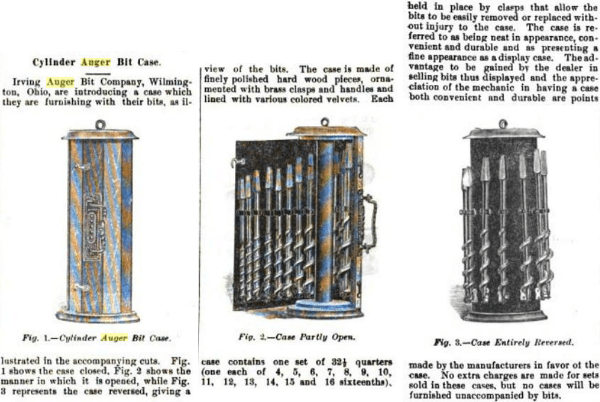
This box will be replaced 2 years later by the Model chest box.
Given its short life span, this box is an absolute rarity, I haven’t seen any, not even in photo. If you have such a box, please contact the author. Call now!
Model chest box
In January 1893, Irwin advertises The new style auger bit case. The black label gives a similar look and feel as the Russel Jennings chest box.

In Scientific American Building Vol 15-16, 1893, the chest is advertised as a Model case, the advertisement shows an auger bit with the Charles Irwin Patent marking:

The Melhuish Catalogue N0 15, 1914 (copyright 1905), shows a drawing of a Patent wood box. 2 sets are available: set of 9 auger bits plus one screw driver bit, set of 13 auger bits. The illustration is of the Farmer‘s set and is signed by “Weisbrodt Gin”. The catalogue has bits advertised as The “Irwin” Patent Auger Bit, illustration shows the Charles Irwin Patent marking

According to a Saturday Evening Post Ad, from 1908-05-16, the new Model set chest box is for Factory and Shop: 32 1/2 quarter, 13 auger bits: 4 to 16, there are two for home and farm: a 20 1/2 quarters, 9 auger bits: 4, 5, 6, 7, 8, 10, 12, 14, 16 plus one 6 inch screw driver and a 25 1/2,11 auger bits: 4, 5, 6, 7, 8, 9, 10, 11, 12, 14, 16, the advertisement shows as well a roll of 13 bits for Carpenters and Mechanics. The marking on the bit is the quoted IRWIN.

In Collier’s Feb 1909, this chest box is advertised has being available with 3 sets: the 20 1/2 quarters, the 25 1/0 quarters and the 32 1/0 quarters, the add shows The IRWIN logo with the bit across, the auger bit is marked with the quoted IRWIN.

In a The Saturday Evening, August 1910, Irwin offers free case and free roll (string attached), the illustration show a chest box with a black label. The logo is with the bit across, but the Reg. U.S. Pat. Off. is now present, placed under the logo. , the Auger bit is marked with the quoted IRWIN.

In Frankfurth Hardware catalog, 1917, available sets are 20 1/2 quarters, and 32 1/2 quarters. The technical description of the bits themselves match the 62-T, which is for sale in the said catalogue. The bits have the unquoted Irwin marking with the Reg US Pat Off.

In Howland Catalogue 24, 1923, again 2 sets are available: No A with 9 auger bits plus one screw driver bit, ans No D with 13 auger bits. The description of the set doesn’t say which auger bit model they contain, but the given characteristics match the 62-T. The same catalogue sells as well the Cabinet set, made of Mainbor in a Borcase.

I have one such box with a full set marked Mainbor, not sure if these were the original bits:

The left part of the label reads:
CONTAINS
One Each
4, 5, 6, 7, 8, 9, 10, 11, 12, 13, 14, 15, 16
Auger Bits
The middle one reads:
One Set 32 1/2 Quarters
Solid-Center Stem Bits
THE IRWIN AUGER BIT COMPANY,
SOLE MANUFACTURERS
WILMINGTON, OHIO, U.S.A.
While the right one reads:
Patented Oct. 21, 1884
AND
Improved April 19, '87
CHAS. H. IRWIN
PATENTEE
Various photo found on the internet suggest that the 2 small slots were used for countersink and turn screw bits (not provided with the box).
Dating a chest box with the ‘patented’ black label:
- These were made ca. the 1890-1920 era.
- Boxes with a lid made of 3 pieces with 2 side triangular inlays are from the earlier period (closer the 1890’s)
- Boxes with a lid made of 3 pieces with 2 rectangular bread-board ends are from the later area (closer to 1920’s)
- If the box is missing the 2 small slot, then it is likely from the 1920’s, which is the transition to the early Borchest. These box should have the bread-board ends.
- TODO: Boxes with a named set (Farmers’ set)
- TODO: Lids made of a single prices of wood, did they exist?
- TODO: associate bit marking with box era. Nickname marking in previous section for ease of reference across document, eg “Charles Irwin patents”, “The Irwin bit patents”, “The Quoted Irwin bit”, “The Unquoted Irwin Bit”
- TODO: lock mechanisms, 2 or 3 hinges, inner vs outer hinges, …
I you have a box with the black label that doesn’t correspond to anything described above, please take some photos and contact the author.
Transitional chest box
Early “Borchest”
The box in itself is almost identical to the previous one, the obvious difference being the label, the 2 small slots are now definitely gone.

The label for the 32 1/2 quarters reads:
THE IRWIN BORCHEST
CARPENTER SET
MAINBOR - No. 62-T
For General Work

No. of Quarters: 32
Thirteen Bits, one each - 4, 5, 6, 7, 8, 9, 10, 11, 12, 13, 14, 15, 16

Stock Number DM
The Bits in this Set are Guaranteed to Deliver Service.

The IRWIN Bit
Reg. U.S. Pat. Office

THE IRWIN AUGER BIT Co., WILMINGTON, OHIO.
The label doesn’t mention Sole manufacturers anymore and instead now have the trademark The IRIWIN Bit. The bit model is Mainbor – 62-T, so it is post-1922
On the photo, on can see that the marking is:
By just searching the internet for “Irwin borchest”, there is evidence of the Handy set (20 1/2 quarters, 4, 5, 6, 7, 8, 10, 14, 16 and 1 driver bit), stock number AM, and the Home set (14 Quarters, 4, 6, 8, 10, 12, 16), stock number BBM.
An undated ad from Router Forum shows a a Borchest Home set of Mainbor, beside the equivalent Borkit (BBR) and Borcase (BBM)

The Albany hardware & iron catalogue, 1927 proposes the Irwin Mainbor Carpenter’s set with an illustration of the Irwin Borchest.
There is evidence of non-named Borchest set, simply referred to as set A, B, C, D. This undated John Hall Catalogue (Bristol, UK), shows a picture of a Borchest set A:

Actually there was as well set AA, BB, CC and DD, as per this photo found on WorthPoint, These sets come with 62-T auger bits (aka Mainbor) and are available in canvas rolls.

Here is a more readable version of the ‘A’ set, thanks to Grandpa’s Little Farm:

The lettered set matches Irwin’s stock number. Add a M (like in model?) for a Borchest stock number, add a R (like in roll?) for a Borkit stock number and add nothing for a Borcase stock number (like?).
Borcase, Borkit and newer Borchest

From the Builders hardware and tools, Catalogue 1926, Fort Pitt Hardware Company Bit, sets available as “case” (Borcase) and “roll” (Borkit) are:
- Little Six: 6 XX bits (4, 5, 6, 8, 10, 12), Borkit: AAR
- Home: 6 XX bits (4, 6, 8, 10, 12, 16), Borkit: BBR
- Handy: 10 XX bits (4, 5, 6, 7, 8, 10, 12, 14, 16 and a screw driver), Borkit: AR
- Carpenter: 13 Mainbor bits (4 to 16), Borkit: DR
- Cabinet: 13 Smoothbor bits (4 to 16), Borcase: DS
In 1930, Borcase is still available and by 1939, the sets are only available in Borchest and Borkit, The Cabinet set seems to have disappeared.
These Borchest have nothing to do with the original one, they are merely a simple box with a lid for small set, and a box that open in 2 halves for larger set. Bits are held in place by spring steel clips.
All sets are available in Irwin, Bluwin and Clinton grades in both Borchest and Borkit.

In 1951, Borchest and Borkit are still available, unchanged it seems, but the family of set was reduced to Carpenter and Handy only, available finishes reduced to Irwin and Bluwin. The description of the Borkit is now missing this sentence:
Made from a good grade of leatherette and lined with flannel

In the 1951 edition there is no mention of the Irwin Trade Mark. The trade mark disappeared somewhere in between the 1940’s and the 1950’s.
Eventually the ‘roll’ will be made of plastic and sold in a cardboard box. The photo below shows such a set, stock number DR, which means the Carpenter Borkit

An ad found in Popular Mechanics, December 1953 says:
Available in beautiful hardwood chests or colorful plastic rolls. Choice of 6, 10, or 13 bit assortments.
So plastic rolls appeared in the early 50’s.
TODO: 1936: “Irwin & Bluwin – Auger bits & screwdrivers”,
Finishes
TODO: Irwin, Clinton, Union and Bluwin
Stock numbers
Bits
| Name | Total length | Twist length | Stock number | 1939 | 1951 | 1955 |
| Mainbor | 7-9″ | 4-5″ | 62-T | x | x | x |
| Smoothbor | 62-TS | ? | ||||
| Carbor | 52-T | x | ||||
| Surebor | 7-9″ | 4-5″ | 32-T | x | ||
| Endbor | 72-T | x | ||||
| Speedbor electrician | 10″ | 6″ | 3-E | x | x | x |
| Surebor electrician | 8 1/2″ | 4 1/2 | 32-T | x | ? | |
| Short electrician | 6″ | 4″ | 31-T | x | ||
| Mainbor dowel | 4 1/2″ | 3″ | 61-T | x | x | |
| Tapbor sugar tree | 6″ | 3 1/2″ | 91-T | x | x | |
| Mainbor car | 12″ | 8″ | 63-T | x | ||
| Carbor car | 12″ | 8″ | 53-T/33-T | 53-T | 33-T | |
| Mainbor car | 18″ | 12″ | 65-T | x | x | x |
| Carbor car | 18″ | 12″ | 55-T | x | x | |
| Surebor car | 18″ | 12″ | 35-T | x | x | x |
TBD: 1930: Soomthbor (for school shop) 62-TS, Borcase DS, Dowel bit 61-T w/ smoothbor head
By 1955, Speedbor now refers to spade bit for electric drills, all other members of the Bor family are gone. Mainbor are referred to by their stock numbers, Borchest and Borkit are still available, but as 62-T Borchest and 62-7 Borkit, in unnamed 13, 10 and 6 bit sets.
Sets
| Stock Letter | Name | Total quarters | 4 | 5 | 6 | 7 | 8 | 9 | 10 | 11 | 12 | 13 | 14 | 15 | 16 | Turn screw | Total Bits | |
| A | Former Home, later Handy | 20 1/2 | 1 | 1 | 1 | 1 | 1 | 1 | 1 | 1 | 1 | 1 | 10 | |||||
| B | ? | 24 | 1 | 1 | 2 | 1 | 2 | 1 | 2 | 1 | 1 | 12 | ||||||
| C | Farmer | 25 1/2 | 1 | 1 | 1 | 1 | 1 | 1 | 1 | 1 | 1 | 1 | 1 | 11 | ||||
| D | Carp-enter, Cabinet | 32 1/2 | 1 | 1 | 1 | 1 | 1 | 1 | 1 | 1 | 1 | 1 | 1 | 1 | 1 | 13 | ||
| AA | Little six | 11 1/4 | 1 | 1 | 1 | 1 | 1 | 1 | 6 | |||||||||
| BB | Home | 14 | 1 | 1 | 1 | 1 | 1 | 1 | 6 | |||||||||
| CC | ? | 10 | 1 | 1 | 1 | 1 | 1 | 1 | 1 | 1 | 1 | 9 | ||||||
| DD | ? | 10 3/4 | 1 | 1 | 1 | 1 | 1 | 1 | 1 | 1 | 8 |
| Stock letter | Borcase | Borchest | Borkit |
| A | A | AM | AR |
| B | B | BM | BR |
| C | C | CM | CR |
| D | D, DS (Cabinet, w/ Smoothbor head) | DM | DR |
| AA | AA | AAM | AAR |
| BB | BB | BBM | BBR |
| CC | CC | CCM | CCR |
| DD | DD | DDM | DDR |
Nothing new under the sun
Interesting article, from Charles A. Strelinger & Co Wood Workers’ Tools 1897 catalogue

Unfortunately the photo is all black, but the text suggests that in 1896, someone had an auger bit for years that strongly resemble the Irwin one.
Playground, TODO and Work in progress area — you can stop reading.
Carpentry and Building, Volume 13, 1891


Official Gazette of the United States Patent Office, Volume 307, 1923


Official Gazette of the United States Patent Office, 1943

1928: Borkit No. DSR or Borcase No. DS
Official Gazette of the United States Patent Office, Volume 689, 1954

Official Gazette of the United States Patent Office, Volume 559. 1944


Official gazette of the United States Patent Office, Volume 355

Official Gazette of the United States Patent Office, Volume 545, 1942

Official Gazette of the United States Patent Office, Volume 311, 1923

Official Gazette of the United States Patent Office, 1954

TODO:
- Color coding and labels attached to the bits.
- 1939: cellophane water-proof wraps
- Add a section dedicated to expansive bits
- Technical details for each of the member of the bor family
- Patent list
Electrical Worker, Sept. 1929

Early patents:
- US306907, Auger bit, Oct. 21, 1884, William M. Dimmit
- US361522, Auger bit, Apr. 19, 1887, Charles H. Irwin
- CA27788, Auger bit die, Oct. 11, 1887, Charles H. Irwin
- US378251, Auger bit die, Feb. 21, 1888, Charles H. Irwin
- US378408, Auger bit die, Feb. 21, 1888, Francis Thomas, Charles H. Irwin
- CA29097, Auger bit, May. 7, 1888, Charles H. Irwin
- US404197, Auger bit, May 28, 1889, Charles H. Irwin
- US412957, Auger bit die, Oct. 15, 1889, Charles H. Irwin, Francis I. Hoefle, James W. Simmons,


Leave a Reply