Welcome to a deep dive into the fascinating world of vintage hand brace bits! In this post, we’ll explore a collection of over 200 marked brace bits, carefully cataloged and photographed. This collection showcases a variety of historical styles and designs, most of the bits were manufactured in the U.K. and Germany, some in the U.S.A.
The collection, made in New Zealand, includes:
- 74 twist nose bits
- 27 counter-sink bits
- 24 center bits
- 17 shell bits
- 15 turn screw bits
- 14 fast-cut center bits
- 13 nose bits
- 12 reamer bits
- 11 twist drill bits
- 4 spoon bits
- 3 dowel bits
It doesn’t include these 100 unnamed bits nor does it feature any type of auger bits.
You can jump to the Conclusion if you’re only interested in statistics. And you can also jump to the huge table of content at the very end of this post.
Buckle your seat belt, we’re in for a long trip!
Twist nose bits
Henry Boker, Solingen, Germany
Henry Boker (Arrow brand) and H. Boker (Tree brand) are different but related companies according to their own website. There’s an interesting forum thread about their trademarks.


In this lot there are two types of stamp. One with just the arrow trademark with a cross and 2 stars, while the other doesn’t have it, but has “GERMANY” on the other side of the tang.
Let’s now go through all the other markings, there’s a a lot to cover.

Ward & Payne, Sheffield, England


The first bit has “D & PAYNE”. The second one has two lines “WARD & PAYNE” and “SHEFFIELD”. The third one has “WARD & PAYNE”. Sizes are 2, 6 and 8 on the tangs.
Historical information can be found on the Trowel Collector, the Grace’s Guide To British Industrial History and the Garage Journal.
Snell, Fiskdale, Mass., U.S.A.


All bits have the same mark: “SNELL U.S.A.”. Sizes are 6, 8, 9, 10 and 11, all marked on the tang.
Historical information can be found in The Old Tool Heaven.
W. Ridgway, Sheffield, England


The second bit from the top allows us to to identify that a the number 268 in an ellipse is a Ridgway mark. (they’ve stamped numbers on many of their brace and auger bits, i’ll cover that in a dedicated blog post). Others have only the number 268 stamp, and some have only “Wm RIDGWAY”. Sizes are two 3, three 6 and one 7.
Historical information can be found in The Grace’s Guide To British Industrial History.
A. Ridge & Sons, Sheffield, England


The two bits have “ALFRID” on the tang. Sizes are two 8, one being unmarked.
Historical information can be found in footprint-tools.com and The Grace’s Guide To British Industrial History.
PRAT


These two bits are marked “PRAT” on the tang.
I haven’t found any information about their origin. Please leave a comment if you know something.
H. Boker, Remscheid, Germany


Both bits have the tree trademark and two lines: “H. BOKER” and “GERMANY”, Sizes on the tangs are 14 and 9.
Check out their website for background about the Boker familly and their companies.
J. E. Morrison, Sheffield, England


The markings on these 3 bits is pretty rough. One reads “RISSON C”, one has “?. MORRISON & CO” and another one has “RISSON”.
There is a mention of J.E. Morrison of Sheffield in nzvtcc.org.nz/european-drill-bits and I found a 1925 address record for Albert MORRISON (Morrison & Co.), Brace & bit manufacturer in The Sheffield Indexers.
J. E. Bleckmann, Solingen, Germany


The first and third bits have 3 lines on the tang: “BLECKMANN”, “SOLINGEN” and “GERMANY”, on the back they have the Bow trademark and the letters C, H and K in a triangle. The middle one has a logo showing a bow pointing upward with a B and a M inside.
Some historical information can be found in The Victorian Collections. There are also several entries in the German Tool and Blade makers.
The CHK in a triangle was registered in 1895 by Hönnecknövel, Remscheid (See page 42 of German Tool and Blade makers)
J. Spring (By H. Boker?)


The two bits are marked “J. Spring” on the tang. Both have size 6 on their tang.
Potentially a trademark of H. Boker, as per a backsaw.net forum thread, citing German Tool and Blade makers:
J. SPRING (1895, no. 6761): Heinrich Böker, Remscheid. Registry class: 9b. Style: roman.
A. Hildick, Sheffield, England


The 2 bits are marked with two lines on the tang: “A. HILDICK” and “SHEFFIELD”. Sizes are 8 and 3, stamped on the tang.
Possibly A. Hildick, as per the Grace’s Guide To British Industrial History or Aaron Hildick, according to Mister G and the Grace’s Guide To British Industrial History.
Made in western Germany


No trademark or company name is visible, only “MADE IN WESTERN GERMANY”. I found it interesting to see a reference to Western Germany, as this indicates the bit was made after WWII.
Ragen mistery


I’m not even sure how to describe the trademark properly. It looks like a fan tail with a circle and a cross at the top. The 2 markings don’t seem to have the same text. The first one is quite short (Maybe 7 letters) and unreadable, it has “GERMANY” marked on the other side of the tang. The second one is longer and may end with “RAGEN”
“S” Mistery


This mystery marking was found on other brace bits, too. It is an S stroke vertically, with the lines ending with left and right curles, both at the top and bottom. Size 8 and 11 marked on the tang.
Miscellaneous markings
Here we have 12 bits with unique markings. For this set, we’ll go through each photo.

Group 1

Fr. Eduard Engels & Co, Remscheid, Germany
On the first photo, we start with a partial “FR. EDUARD” and “ENGELS & CO”, the trademark looks like a furnace filled with plates. Size 5 on the tang.
This is a German made bit, which is also referenced in nzvtcc.org.nz/european-drill-bits. The Porch said they are from Remsheid and Wolfgang Jordan Small Tool Museum has a trademark entry for Eduard Engels jun., Remscheid.
For the fun, check out this interesting ice skate manufacturing story, they mention (another?) Eduard Engels from Remscheid, Germany.
J. Tyzack & Son, Sheffield, England
Then we have a two-liner “J. TYZACK & SON” and “SHEFFIELD”. Size 5 on the tang.
Historical information can be found in Hawley Sheffield Knives, the Grace’s Guide To British Industrial History and the Trowel Collector.
Kammerling, Elberfeld, Germany
Next is another two-liner “KAMMERLING” and “ELBERFELD”. Size 4 on the tang.
A possible match is Carl Kammering, check their own historical information.
Bodmann & Co, Reinscheid, Germany
And finally, we have a “BODMANN” mark on the tang.
Historical information can be found in the Victorian Collections and the Jeep Wrangler TJ Forum.
Group 2


P. L. Schmidt, Elberfeld, Germany
The first bit has a marking that starts with a small P, a big S and a small L in a vertical ellipse, and two lines “SCHMIDT” and “ELBERFELD”. Size 7 on the tang.
This matches Peter Ludwig Schmidt and is linked to the previously mentioned Kammerling (see this Papa’s wrench forum thread and Vintage Tool Shop).
The PLS trademark was registered in 1902 according to German Tool and Blade Makers on page 95.
Number 5 mistery
Then we have a no-name size 6, it has a number 5 in a circle on the shank.
Ahrem’s Goodline, Germany (Brand)
The next bit has two lines “GOODLINE” and “GERMANY”. Size 6 on the tang.
Ahrem’s Goodline tools were manufactured in Germany, likely by various tool makers, as “Ahrem’s Goodline” was a brand name used by a merchant or wholesaler, rather than a specific manufacturer. The target markets were Australia, New Zealand and South Africa. See Candelo Service Station antique shop and The Porch.
Hammel, Solingen, Germany
The last bit has two lines “HAMMEL” and “SOLINGEN”, and “GERMANY” on the back.
This could be a Bleckmann brand registered in 1899, see page 64 of German Tool and Blade Makers.
Group 3


Hilger & Söhne, Remscheid, Germany
The first bit has a stamp on the tang that represents an H with a sort of spike above it’s horizontal stroke, in a cerated vertical ellipse. Size 10 stamped on the tang.
German Tool and Blade Makers has a solid match on page 63:
H, beneath a flower (tulip?), in a dotted
oval border (1895, no. 2224): Hilger &
Söhne, Remscheid. Registry class: 9b.
Style: roman. Note: the stalk of the flower
springs vertically from the mid-point of
the ‘H’ crossbar.
J.A. Henckels, Solingen, Germany
The second one has a snake and two lines “HENSKELS & Co” and “GERMANY”. It’s hard to read, so the name might be slightly different. Size 9 on the tang.
There is multiple “HENCKELS” matches in German Tool and Blade Makers (Note: HENCKELS vs HENSKELS), it lists J.A. Henkels and P.A. Henkels. A quick search on the internet return a few auctions for “J.A. HENSKELS” scisors and razors. Given that the marking is hard to read, I conclude that this is indeed a J.A. Henckels, of Solingen, Germany.
J. P. Hasenclever & Söhne, Germany (possibly)
The third bit as a 4-legs animal with what looks like wings (a griffin?), it has two lines “J.P. HASEN” and “CLEVER”.
There are several entries for “J.B. Hasenclever & Söhne” (with a B, not P) in German Tool and Blade Makers.
Aspari & Co, Germany
Finally, we have a two-liner with “ASPARI & CO” and “?A??”, it has “GERMANY” on the back. I didn’t find anything about ASPARI. If you know something, please leave a comment.
W. Ridgway, Sheffield, England (possibly)


William Ridgway has been marking numbers on their brace bits, on and off. In this post, you will see a reference to number 268. Here we have number 220. This could be a Ridgway bit, this is clearly highly speculative, thought.
Impossible to read


Let’s ignore the first bit that has a “R. WARD”, as explained further down, one day I got a lot of bits which came with “customised” bits and a “J. WARD” stamp. I suspect this lot came from a familly that were in a business involving brace bits.
The second bit is unreadable, the third one has 2 lines: one that starts with W, and “SHEFFIELD”. With low confidence, I would say that the last bit is marked “W. JAKER”.
Shell bits

Henry Boker, Solingen, Germany


Here we have two bits, one with the arrow trademark and two lines “HENRY” and “BOKER”, size 6. The other one doesn’t have the logo, size 4.
T. Ibbotson & Co, Sheffield, England


The first bit has three markings. “THOS IBBOTSON & CO” and “CAST STELL” inside the shell. And it has “R. WARD” on the tang, which is likely an owner’s mark as these bits were part of a lot of that came with a “J. WARD” stamp. The second bit, with a shortened shaft and custom made tang, has a partial “THOS IBBOTSON & CO” marking and no cast steel. Both bits have no size marking on their tangs.
Historical details can be found in the Grace’s Guide To British Industrial History and Hawley Sheffield Knives.
A. Mathieson & Sons, Glasgow, Scotland


The first, third and last bits have “MATHIESON” followed by the crescent trademark, inside the shell part. The second bit has the same marking but on the shank. None of the bits have a size mark.
Historical information can be found on Wikipedia and Vintage Machinery. You can also find dating guidelines from Hans Brunner Tools.
Miscellaneous markings
Group 1

John Wilson, Sheffield, England
The first bit has two lines on the shank: “JOHN WILSON” and “CAST STEEL”, no size.
Possibly a Joiner’s (later edge) tool makers from before 1868 to c.1907 according to The Porch.
Size 6 mistery
The second bit seems to have a stamp overwritting another one, with some extra damage, these marks can’t be read. It has a size 6 on the tang.
J. E. Bleckmann, Solingen, Germany
The third bit has “BLECKMANN” and “SOLINGEN” surrounding a bow logo with a B and a M inside it. Size 5.
C. Nurse & Co, London, England
The last one has “3/32” or “5/32” size mark on the tang, and “NURSE & C” on the other side, it is missing the final “O”.
The internet archive has a 1902 catalogue. The Porch told us that “The original C (Charles) Nurse worked from 1841 to 1886. The firm became C Nurse & Co in 1887 and continued until 1937.
Group 2


“S” mistery
The first bit has a “S” stroke vertically, size 4 on the tang. This marking was already covered.
Harem, Germany?
The second one is really hard to read, my guess is “HAREM”.
I found a reference in nzvtcc.org.nz/european-drill-bits. Could this be related to Harem’s Goodline brand?
Fr. Eduard Engels & Co, Germany
The third has a partial marking, it has a logo that looks like a furnace to me. Then there are two lines that read “FR. EDUARD” and “ENGELS & CO”, size 3 on the tang.
W. Marples & Sons, Sheffield, England


The first and third one have clean markings: “W. MARPLES & SONS”, the second one is a fair guess with only the bottom part of “W. MARPLES”. All of the same size, maybe 8. It is interesting to note that the marking uses “M.”, not “Wm”. Then there is no shamrocks, no “HIBERNIA” and no mention of Sheffield or England. This could be explained by the limited space available for a bigger stamp, or it could indicate an older bit.
Historical information can be found in Roger P. Ball’s study and Grace’s Guide To British Industrial History. Dating guidelines can also be found in Roger P. Ball’s study.
Nose bits
This is going to be very quick as most of my nose bits have no markings.

Thomson (Glasgow or Sheffield)


Two bits have a “THOMSON” mark in the shell part. No size markings are visible.
There were four bits with the same marking for sale at the Old Tools Ltd shop. NZVTCC (New Zealand Vintage Tools Collector Club) mentions “Thomson, H. Broomhall Works, Broomhall Street, Sheffield. An edge tool manufacturer. (1871- )”. This could be a match…
But I also found some mentions of Thomson, Glasgow on Ebay and Ted Dawson Antique Tools.
W. Marples & Sons, Sheffield, England


See my comment in the “Shell bits” section. This bit has the same “W. MARPLES & SONS” marking, without trademark, …
Spoon bits


I only have 3 spoon bits. I am not sure if the fourth one should be considered a spoon bit, as it has a screw instead of the scooping end. Moreover, it has no marking.
Thomson (Glasgow or Sheffield)
The first bit has “THOMSON” in the shell part, no size.
Henry Boker, Solingen, Germany
The second one has two lines: “HENRY” and “BOKER”, no arrow trademark, size 4 on the tang.
“JAPI” mistery
The third one has not much left of its original marking. A wild guess is “JAPI”, mystery….
Center bits

D. Flather & Sons, Sheffield, England


The two bits have two lines: “D. FLATHER & SONS” and “SHEFFIELD”.
Historical information can be found in the Grace’s Guide To British Industrial History.
Atkin & Sons, Sheffield, England


Both bits are marked “ATKIN & SONS” on their shank.
The Porch provides us with information from Goodman’s British Planemakers from 1700:
Atkin & Son: 96 Barford St.: 1839 – 1845
Atkin & Sons: 96 & 97 Barford St.: 1847 – 1854
58 Ludgate Hill: 1854
Sheffield Works, Rea St,: 1855 – 1900
Atkin & Sons, Ltd: Sheffield Works, Rea St.: 1902 – 1930
Atkin & Sons (1931) Ltd.: 98 Barford Str.: 1931 – 1966
H. Boker, Germany


Here we have two bits with the tree brand and two lines “H. BOKER” and “GERMANY”. Sizes 7/8 and 3/8 stameped on the tang.
Ward & Payne, Sheffield, England


Two bits have “WARD & PAYNE” on the tang, the third one has “WARD & PAYNE” on the shank.
T. Ibbotson & Co, Sheffield, England


The marking is partial. the “THOS” and “&CO” are partly visible, but with such an uncommon name, it is quite easy to read “THOS IBBOTSON & CO”. It has size “2” marked near the tang.
This is a big bit, it might work if you want to drill a 2″/5cm hole in butter.
Miscellaneous markings
Group 1


A. Ridge & Sons, Sheffield, England
The first bit has “ALFRID” in a single frame, on the shank.
Thomson (Glasgow or Sheffield)
The second one has “THOMSON” on the shank.
Allen?
The next one has a damaged marking, and it looks like “ALLEN”.
No information were found. There is a Allen & Co, New Haven, Conn., U.S.A. but this doesn’t sound like a fit, as most (all?) center bits I have are British or German made.
O. Moulson?
The last bit is hard to read. My guess is “O. MOULSON”. First letter could be a C, G, O or a Q.
Historical information about the Moulson brothers can be found in Hawley Sheffield Knives, the Grace’s Guide To British Industrial History, and The Porch gives us some quotes from Some 19th Century English Woodworking Tools, by Kenneth D. Roberts and British Planemakers from 1700, by William L. Goodman.
None of the brothers’ first name match the first letter of the marking…
Group 2


Colqhoun & Cadman, Sheffield, England
The first bit has two lines “COLQHOUN” “& CADMAN”, and size “3/4” marked on the shank.
Historical information can be found in Hawley Sheffield Knives, in a Backsaw forum thread and an advertisement can be seen at Picture Sheffield.
Spoon mistery
The second bit is completely unreadable. It has a trademark that looks like a spoon or hook, inside an ellipse. There’s some arched text above and below it.
J. E. Bleckmann, Solingen, Germany
The third bit has two lines: “BLECKMANN” and “SOLINGEN” and “GERMANY” on the right.
H. B & S
The fourth bit has “H. B & S” on the shank.
No interesting information were found. Please leave a comment is you know something.
Robert Sorby & Son
The last one has two lines: “ROBt SORBY & SON” and “CAST STEEL”
Historical information can be found on their own website, in the Grace’s Guide To British Industrial History and on the Sheffielder blog.
C. Nurse & Co, London, England


Here we have 8 bits marked with “C. NURSE & CO”, some have only a partial mark.
A. Mathieson & Sons, Glasgow, Scotland


Here we have 10 bits, all marked with “MATHIESON”, some followed by the crescent and star trademark.
W. Marples & Sons, Sheffield, England


This lot has three different markings. Two lines “W. MARPLES” and “&SONS”, two lines “W. MARPLES & SONS” and “SHEFFIELD ENG.” and three lines “W. MARPLES”, “& SONS” and “HIBERNIA”. All bits have the triple shamrock trademark.
And here are 2 counter bore bits. Both have two lines “W. MARPLES” and “&SONS” and the triple shamerock trademark.


Turn screw bits

W. Marples & Sons, Sheffield, England


We have two different markings here, the 2 liners with “W. MARPLES” and “& SONS”, with the triple shamerock trademark. The other one has 3 lines “W. MARPLES”, “& SONS” and “HIBERNIA”. It has a *single* shamerock, which dates it to 1862-1875 according to Roger P. Ball’s study.
J. E. Bleckmann, Solingen, Germany


These two bits have the two-liner “BLECKMANN” and “SOLINGER”, one has “GERMANY” stamped on the back.
Butterfield Bros, Oldham, England


The first bit has two lines: “BUTTERFIELD BR” and “OLDHAM”, the second one has “BUTTERFIELD BROS” (faint O and S) and “OLDHAM”.
I’ve found a couple of Butterfield Bros, some even in Oldham, but their activities doesn’t fit with tool manufacturing. The closest i’ve found is a tool dealer mentioned on page 438 of Wireless-Weekly (1924-03-S-OCR).
Charles Taylor’s Sheffield Tools Ltd., Sheffield, England


The 2 bits have the exact same markings. 2 lines with “CHARLES TAYLOR’S” and “SHEFFIELD TOOLS Ltd”, on the other side there’s a wood screw marking.
Historical information about “The Screw Brand” can be found in the Grace’s Guide To British Industrial History, and some of their chisels can be seen in a Barold’s Tools post.
Miscellaneous markings
Group 1


D. Flather & Sons, Sheffield, England
This bit has “D. FLATHER & SONS” and “SHEFFIELD” on the shank.
C. Johnson & Co, Sheffield, England
Here we have a flag with “C. J” and “JOHNSON” along the flag’s pole, in “portrait mode” on the shank.
It is worth noting that there are other Johnson bits in “landscape mode”, where “JOHNSON” is marked on the right of the flag.
C. Nurse & Co, London, England
Another “NURSE & C” along the shank.
Thomson (Glasgow or Sheffield)
Another “THOMSON” along the shank.
Henry Boker, Solingen, Germany
Arrow trademark and 2 lines with “HENRY” and “BOKER” on the shank.
Group 2


Stanley, New Britain, U.S.A.
The first bit has the “STANLEY” frame with the Sweat Heart, underneath is damaged, I’m guessing a “MADE IN U.S.A.”. Marking is across the shank.
The third bit has the “STANLEY” frame, “MADE IN U.S.A.” and “No. 26 – 3/8” on 3 lines, along the shank.
A. Ridge & Sons, Sheffield, England
The second bit has 3 lines “ALFRID”, “SHEFFIELD” and “ENGLAND” in a double frame.
Irwin, Wilmington, U.S.A.
This bit has “IRWIN – US of A” on the shank.
This can be dated to the 1950’s, based on Randy Roeder’s study. I previously did a quick investigation into Irwin’s history, and I highly recomend Randy’s website without hesitation.
Footprint, Sheffield, England
The last bit has 4 lines: “FOOTPRINT”, “SUPER”, “CHROME” and “VANADIUM” (some letters missing).
It is worth noting that I have another ALFRID bit with the same super chrome vanadium. The 2 companies are linked.
Group 3


E. Lineley & Co, sheffield, England
Two bits with two lines “E. LINLEY & CO” and “SHEFFIELD” (some letters missing).
The only information I have found references to a shear maker with the “Sheperd” brand in the online National Library of Australia. This trademark was found on chisels (Tooltique, Ebay and more). The Grace’s Guide to British Industrial has a corresponding entry.
Stanley, New Britain, U.S.A.
This bit has the “STANLEY” frame, with “MADE IN U.S.A.” and “No. 26 – 5/16” on two lines underneath.
Irwin, Wilmington, U.S.A.
The following one has “IRWIN – US of A” along the shank.
Historical information and identification can be found in Randy Roeder’s study.
Footprint, Sheffield, England
This bit has the footprint trademark on the shank with 3 lines below: “FOOTPRINT” (faint), “SHEFFIELD” and “ENGLAND”. Size “5/16” on the tang.
Stiletto, San Francisco, U.S.A.
The last bit has “STILETTO” stroke through on the shank. This could be a repurposed bit.
Historical information can be found on their own website.
Group 4
Here we have three double screw-drivers.


J. Tyzack & Sons, Sheffield, England
The first one has two lines: “J. TYZACK & SONS” and “SHEFFIELD”
W. Ridgway, Sheffield, England
“Wm RIDGWAY”, “SHEFFIELD”, “MADE IN ENGLAND” on three lines.
A. Ridge & Sons, Sheffield, England
The third one has a similar marking found on a Footprint bit: it has four lines with “ALFRID”, “SUPER”, “CHROME” and “VANADIUM”, all in a single frame.
Frankenbits
Here are seven “frankenbits”, these were repurposed using hammer, grinder and forges. They suffered a tough life.


C. Whitehouse & Sons, Cannock, England
Of the first two bits, one has “WHITEHOUSE CORNELIUS & SONS” and “INVENTORS”, the other has “CORNELIUS” and “WHITEHOUSE”. These were very likely bullnose auger bits.
Historical information can be found on Grace’s guide. The Whitehouse and Gilpin story deserves its own blog post.
W. Jaker?
The next bit is hard to read, my guess is “W. JAKER”, with low confidence.
Ward?
Then a two-liner “WARD” and “CAST STEEL”
Butterfield Bros, Oldham, England
Another bit with two lines “BUTTERFIELD BR” and “OLDHAM”.
Thomson (Glasgow or Sheffield)
The following bit has “THOMSON” on the shank, near the tang.
John Wilson, Sheffield, England
We finish with the last two “monster” bits, both have a two-liner “JOHN WILSON” and “SHEFFIELD”, with what looks like a running dog on the other side. One bit has a mark saying “TO BORE”.
Historical information can be found in Hawley Sheffield Knives and Grace’s Guide To British Industrial History. Some contradicting information can be found in a NZVTCC blog.
Counter sink bits

W. Marples & Sons, Sheffield, England


Nothing special here, we’ve covered these marking several times already.
Ward & Payne, sheffield, England.


The first bit has two lines: “WARD & PAYNE” and “SHEFFIELD” on the shank, the second one has “RD & PAYNE” and “MADE IN ENGLAND” on the tang.
Miscalenous names
Group 1
Let’s start with 6 rose counter-sink.


Robert Sorby & Sons
The first one has a cross trademark and two lines “ROBt SORBY” and “CAST STEEL”.
Historical information can be found on their own website.
Spear & Jackson, Sheffield, England
The second bit has two lines “SPEAR & JACKSON” and “SHEFFIELD”. Not easy to spot (Unless you have some of their saws), but the marking might be preceded by a crown trademark. I even made a design for t-shirst, caps, … on my RedBubble shop.
Historical information can be found on their own website and in Grace’s Guide To British Industrial History.
H. Osborn, Newcastle, England
Next we have a two liner with “Hy OSBORN” and likely “NEW CASTLE”. There’s an empty entry in Grace’s guide, and The Porch gives us details from the Goodman’s British Planemakers from 1700 book.
C. Johnson & Co, Sheffield, England
Next, we have a hard to read bit, but we’ve seen this already. It has a flag and two lines on the right, hard to read, but this looks like a C. J. Johnson bit. The difference with the other bit is that the writing is in the direction of the flag, not along its pole.
It looks like the company is Christopher Johnson & Co, of Sheffield, England. There’s an interesting video from 1928 showing the work in their factory.
Historical details can be found in the The International Correspondence of Corkscrew Addicts. It is noteworthy that this brand targeted mainly the Australia and New Zeland market:
In the 1880’s the business had almost 200 employees, mostly in the Western Works factory in Portobello St Sheffield. The major export
markets were Australia and New Zealand.
J. Howarth, Sheffield, England
The next one is also hard to read, it has two lines, my guess is “D. HOWAR” and the second line is definitely “SHEFFIELD”.
From nzvtcc.org.nz/european-drill-bits, we have a candidate:
Howarth, James. Broomspring Works, Sheffield. Manufactured edge tools and joiners tools (1835- )
Historical information can be found in this Sheffield History Forum thread.
J. E. Morrison & Sons, Sheffield, England
The next bit has two lines “E. MORRISON & SO” and “SHEFFIELD”.
Group 2
Let’s go through the next lot of six bits.


J. Tyzack & Son, Sheffield, England
The first has “J. TYZACK & SON SHEFFIELD” on the tang.
J. E. Bleckmann, Solingen, Germany
Next is a Bleckmann bit. It has a snake followed by two lines “J.E. BLECKMANN” and “SOLINGEN”, on the tangs.
J. E. Beckmann registered the cobra trademark, see page 129 of German Tool and Blade markers.
Bodmann & Co, Reinscheid, Germany
Next is a bit with “BODMANN” on the tang.
A. Ridge & Sons, Sheffield, England
Next one has “ALFRID” “SHEFFIELD” and “ENGLAND” in a double frame on the shank.
Old phone mistery
Finally we have a bit with just a trademark. An old phone stamped on the tang.
There is a potential match in German Tool and Blade markers:
Telephone: Ewald Siepmann & Co
Group 3


471?
The first bit has “471” on the tang, size “3/8” on the other side.
A highly speculative identification is W. Ridgway, Sheffield. England.
True tamper?
The next bit has 2 lines on the tang: “TRUE” and “TAMPER”, with a lot of pitting. Size on the other side is marked “?/8”, with a lot of pitting, too.
Bodmann & Co, Reinscheid, Germany
The next bit has “BODMANN” on the tang, and size “1/2” on the other side.
C. E. Jennings & Co., New York, U.S.A.
This bit has a damaged marking along the shank that starts with “CE JENNING”. The tang has been modified to fit a moren drill chunk.
Sparta?, Germany
The last bit has a trademark on the tang that ressembles a lion, warrior or animal holding a Spartan sword. There is a line underneath. After a second look, it could very well be a Spartan warrior wearing an helmet and holding a sword in front of him, with only the neck and head visible. What looked initially like a fish tail could be the warrior’s cape floating in the wind.
Size “3/8” stamped on the tang and “MADE IN GERMANY” on the other side
Group 4
The next group is a set of 5 flat-head countersink bits.


W. Marples & Sons, Sheffield, England
Nothing special on this bt, the marking was already covered several times.
A. Mathieson & Sons, Glasgow, Scotland
The following bit has “MATHIESON” along the shank, no crescent trademark.
Charles Taylor’s Sheffield Tools Ltd., Sheffield, England
This bit has two lines “CHARLES TAYLOR’S” and “SHEFFIELD TOOLS Ltd”, overlapping with the size mark “3/8” or “5/8”.
H. Pasley, Sheffield, England
The next bit has “HENRY PASLEY” along the shank.
There’s an (almost empty) entry in Grace’s Guide To British Industrial History, a 1900 advertisement in Picture Sheffield and a breast drill in a New Zealand Vintage Tool Collector Club post.
Bleckmann, Solingen, Germany
TODO
Group 5


Mayhew, Mass., U.S.A.
This bit has “MAYHEW” in a diamond across the shank.
The company still exists today. Historical information can be found in Alloy Artifacts.
R. Marples, Sheffield, England
This bit has three lines along the shank: “ROBERT MARPLES”, “HERMITAGE WORKS” and “SHEFFIELD”. On the other side (not pictured), it has a trademark that looks like a man with long hairs and long beard in a circle, with the word “HERMITAGE” running on the bottom of the circle.
Historical information (and a visual of the trademark) can be found in Hawley Sheffield Knives. A 1859 advertisement is available in Picture Sheffield. There also an entry in Grace’s Guide To British Industrial History.
W. Marples & Sons, Sheffield, England
The last two bits have the two liner “MARPLES” and “&Sons” along the shank, with the tripple shamrock on the right
Group 6


Stanley, New Britain, U.S.A.
Both bits are nickel plated, oone has “STANLEY” on the tang in the direction of the shank, the other bit has two lines “STANLEY and “MADE IN U.S.A.”.
It could be the #18 countersink bit, listed as nickel plated in their 1914 catalogue from The Internet Archive. Some more information is available in a The Valley Woodworker post.
Reamer bits


W. Marples & Sons, Sheffield, England
Here we have three hollow reamer bits and one square reamer bit.
One has “W. MARPLES & S”, the second one has “LES & SONS” with only the bottom part of “LE”, the third one has only “SON” readable. All marked in the hollow part.
The square reamer bit is interesting as it features only the tripple shamrock. Nothing else can be seen anywhere. The shamerock stem starts on the shank near the tang and points toward the end of the bit. This looks like a one of a kind Marples marking.
A. Mathieson & Sons, Glasgow, Scotland
This square reamer bit had “MATHIESON” followed by the crescent and star trademark.
Twist drill bits
I’ve never really been into collecting these kind of brace bits, they came as part of lots with other interesting bits.


Cleveland C.T.D. Co, Ohio, U.S.A.
One bit has size “5/16” with the C in a diamond trademark. The second one has number “315”, the C in a diamond trademark and size “13” more or less on the same line. Underneath is a frame with two lines one ends with “T.D. Co” and the other one ends with “OHIO U.S.A.”. The third bit has the number “2461” and the C in a diamond trademark on the same line. Underneath that, there’s a frame with two lines: “CLEVELAND D.T.C. Co” and “CLEVELAND OHIO U.S.A.”. On the right is the size “13/32”.
Historical information can be found on the Greenfield Industries website, they now own the C in a diamond brand.
Whitman & Barnes Mfg. Company, Ohio, U.S.A.
This bit has the size “13/32”, followed by an isolated Z letter, then comaes the trademark: a kind of a diamond with “W” on the left, “&” at the top and “B” on the right. The diamond is filled with 3 arched lines: “MADE”, “IN”, “U.S.A.”.
Historical information and details of the trademark can be found in Alloy Artifacts.
S. B & N
This bit has “S. B & N” across the shank and size “1/2” on the tang.
Easterbrook, Allcard and Co, Sheffield, Engand (Possibly)
This bit has the size “5/16” across the shank, followed by three lines “EASTER”, “BROOKS” and “C.S.”.
There’s a potential match with Easterbrook, Allcard and Co in the Grace’s Guide To British Industrial History. This company is now part of Presto Tools.
British made mistery
This bit has a partial marking on the tang. It has two lines in a single frame. The first line is unreadable, it might contains a V and a A. the second line reads “BRITISH MADE”.
Marsh Brothers, Sheffield, England (Possibly)
This bits has two lines across the shank: “MARSH” and “SHEFFIELD”, it has size “1/4” on the tang with “CS” underneath it.
There’s a potential match with Marsh Brothers in Hawley Sheffield Knives and in Grace’s Guide To British Industrial History.
Morse Twist Drill and Machine Co, Mass., U.S.A. (Possibly)
The last bit has “MORSE” across the shank, followed by the size “1/4”. There is an isolated M above. The M has two little bars at the top of the external vertical bars.
The only potential match I’ve found is Morse Twist Drill and Machine Co, Mass, U.S.A. There’s an entry in Grace’s Guide To British Industrial History.
Fast-cut center bits


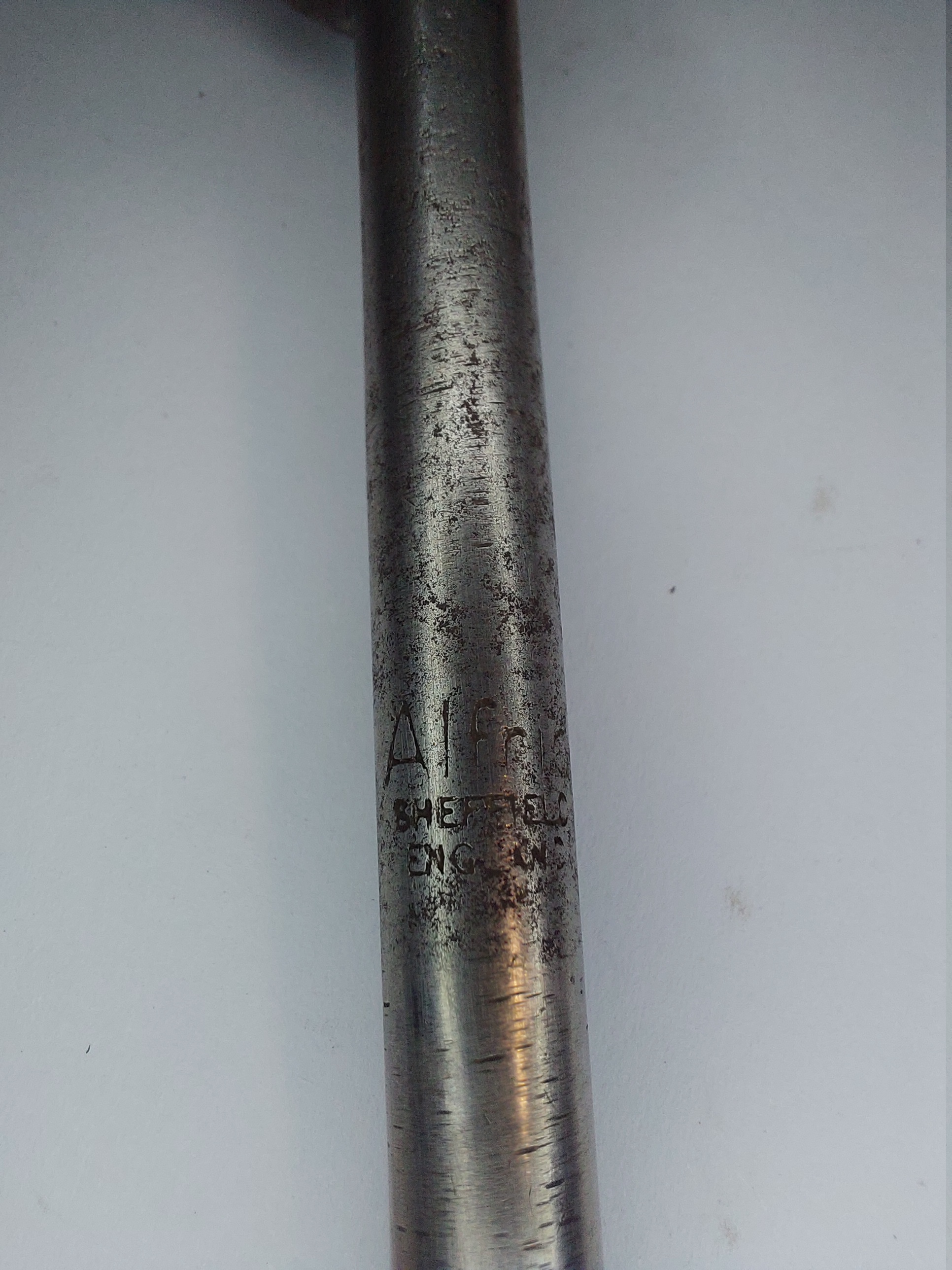

W. Gilpin & Co, Cannock, England (Possibly)
The first bit has two lines along the shank: “GILPINS” and “CANNOCK”, with the size on the right, “11/16” in a double frame.
It is not clear if Gilpins (with a S) is directly related to W. Gilpin & Son, later renamed W. Gilpin, Senior & Co. The S in “Gilpins” could be for “Senior”. There’s an entry in the Grace’s Guide To British Industrial History and The Porch has also some detail information taken from a directory.
C. Whitehouse & Sons, Cannock, England
The next bit has three lines in a single frame along the shank: “CORNELIUS”, “WHITEHOUSE & SONS” and “CANNOCK”.
Footprint, Sheffield, England
The next two bits are by Footprint. The first one has the Footprint trademark and 3 lines, all in a single frame: “FOOTPRINT”, “SHEFFIELD” and “ENGLAND”. The second one has the same but without the frame.
W. Marples & Sons, Sheffield, England
The next bit has two lines: “MARPLES & SONS”, “SHEFFIELD ENG.” with the tripple shamerock on the right.
W. Ridgway, Sheffield, England
Then we have a bit with two lines “Wm. RIDGWAY” and “SHEFFIELD”, underneath is the “Power” trademark, and another two lines “MADE IN” and “ENGLAND”. The trademark shows a man standing and holding a long and heavy hammer, as he is about to hit something, with “POWER” underneath, all in a single frame.
Another bit looks more modern and has 5 lines across the shank: Size “1 1/8”, “Wm. RIDGWAY”, “SHEFFIELD”, “MADE IN ENGLAND” and the number “1066”. It has no Power trademark.
Gibson (by W. Ridgway?)
The following bit is really interesting. It has two lines in a single frame across the shank: “GIBSON” and “SHEFFIELD MADE”. but it has a surprising Rigway’s Power trademark across the shank naer the tang. Size “3/8” on the tang.
I haven’t found any information about this Gibson. The Grace’s guide has a lot of entry for this family name, Eric Brown (2024) reports a Gibson auger bit as:
Marked “GIBSON”, “SHEFFIELD MADE”, two line vertical around shaft. Size marked 9/16 on tang.
A. Ridge & Sons, Sheffield, England
This set of 6 bits has 3 different markings. Three bits have 3 lines “ALFRID” “SHEFFIELD” and “ENGLAND” in a double frame across the shank. Two bits have the same marking but without a frame and “Alfrid” is capitalised and is marked with a sans-serif font. The last bit is very faint and has “ALFRID” in a single frame across the shank.
Dowel bits


Stanley, New Britain, U.S.A.
I only have 3 such bits, and they are all made by Stanley. One has “STANLEY” on the tang, and nothing else. The second one has two lines: “STANLEY” and “MADE IN USA”. The third one has the framed Stanley logo, with “MADE IN USA” underneath.
It could be the #22 Dowel Sharpener bit, list as nickel plated in their 1914 catalogue from The Internet Archive.
No name bits
About 100 bits without any markings.

Conclusion
Creating this blog post was definitely a labor of love. It all started with cleaning up the derusted, oily, and dirty bits. I carefully treated them with a methylated spirit bath and used a soft brush mounted on a rotary tool to bring them back to life. After cleaning, I moved on to the detailed process of sorting, grouping, and taking photos of each bit. Describing each one was a meticulous task, and the research took considerable time, but it was worth it to provide accurate and meaningful information.
Let’s now extract some statistics!
Top manufacturers by number of bits
W. Marples & Sons is the winner with 33 bits, closely followed by Henry Boker with 29, then comes A. Mathieson & Sons with 13. It is really surprising to not have seen a single twist-nose bit made by Marples. It is worth mentioning that there are 32 manufacturers with a single bit in my collection.
| W. Marples & Sons, Sheffield, England | England | 33 |
| Henry Boker, Solingen, Germany | Germany | 29 |
| A. Mathieson & Sons, Glasgow, Scotland | Scotland | 13 |
| W. Ridgway, Sheffield, England | England | 10 |
| J. E. Bleckmann, Solingen, Germany | Germany | 9 |
| C. Nurse & Co, London, England | England | 9 |
| A. Ridge & Sons, Sheffield, England | England | 8 |
| Stanley, New Britain, U.S.A. | U.S.A. | 8 |
| Thomson (Glasgow or Sheffield) | 6 | |
| Snell, Fiskdale, Mass., U.S.A. | U.S.A. | 5 |
| Ward & Payne, Sheffield, England | England | 5 |
| Charles Taylor’s Sheffield Tools Ltd., Sheffield, England | England | 5 |
| J. E. Morrison, Sheffield, England | England | 4 |
| Footprint, Sheffield, England | England | 4 |
Top Countries by number of manufacturers
| England | 32 |
| Germany | 17 |
| U.S.A. | 9 |
| Scotland | 1 |
Top Countries by number of bits
| Made in England | 123 |
| Made in Germany | 60 |
| Made in the U.S.A. | 23 |
| Made in Scotland | 13 |
I would like to take this opportunity to let the reader knows that I made some cool “old tools” designs on RedBubble. You can buy gallot stickers, t-shirts, … My margin is currently ZERO so the price is as low as I can control. So far I’ve “sold” 13 items, all Stanley related, weird! If you buy something, please leave a feedback.
References
Non exhaustive list, in no particular order:
- The Porch (aka. Old Tools mailing list) old and new archives. Google search tip: prepend “site:swingleydev.com” to your Google search. eg “C.E. Jennings site:swingleydev.com“
Here is a copy that covers the period 1850-2000, published in 2014.
His work is based on a 1942 german book.
- Old tool heaven website, by Randy Roeder
- Sheffield History website.
- Is your name on a knife? (Based on Geoffrey Tweedale, Directory of Sheffield Cutlery Manufacturers, 1740-2022?)
- Eric Brown’s Auger maker List
- and many more…
Table of content
- Twist nose bits
- Henry Boker, Solingen, Germany
- Ward & Payne, Sheffield, England
- Snell, Fiskdale, Mass., U.S.A.
- W. Ridgway, Sheffield, England
- A. Ridge & Sons, Sheffield, England
- PRAT
- H. Boker, Remscheid, Germany
- J. E. Morrison, Sheffield, England
- J. E. Bleckmann, Solingen, Germany
- J. Spring (By H. Boker?)
- A. Hildick, Sheffield, England
- Made in western Germany
- Ragen mistery
- “S” Mistery
- Miscellaneous markings
- W. Ridgway, Sheffield, England (possibly)
- Impossible to read
- Shell bits
- Nose bits
- Spoon bits
- Center bits
- Turn screw bits
- Counter sink bits
- Reamer bits
- Twist drill bits
- Fast-cut center bits
- Dowel bits
- No name bits
- Conclusion
- References
- Table of content


Leave a Reply